
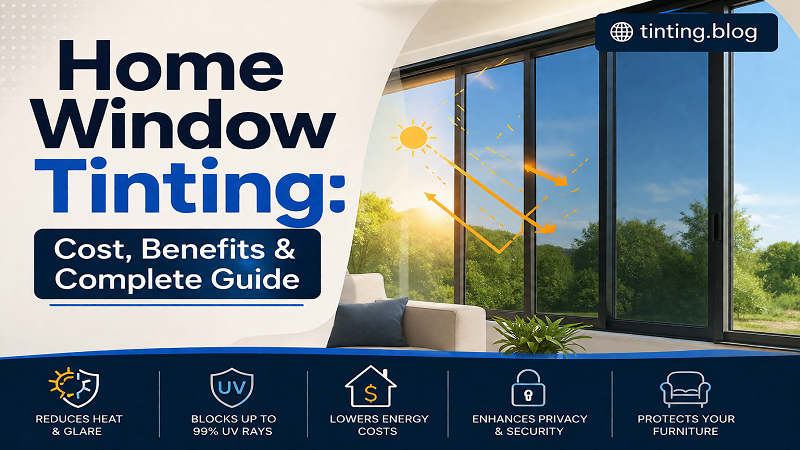
Have you ever sat in your living room and felt like you were baking under a heat lamp? Or maybe you’ve tried watching TV, only to be blinded by an annoying sun glare reflecting off the screen. For many of us, our home’s windows are a blessing for natural light, but a curse for comfort.
That is exactly why home window tinting has exploded in popularity. Instead of ripping out perfectly good glass and spending a fortune on window replacements, you can apply a micro-thin, specialized polyester or ceramic laminate directly onto your current windows. Think of it like high-performance sunglasses for your house. It keeps your rooms beautifully bright while quietly bouncing away up to 84% of solar heat and 99.9% of damaging ultraviolet (UV) rays.
Whether you want to lower your exploding summer utility bills, shield your expensive hardwood floors from fading, or finally get some privacy from the neighbors, this guide covers everything you need to know.
What Is Home Window Tinting? Everything You Need to Know
At its core, residential window tinting is an easy upgrade for your existing glass. It involves retrofitting your windows with a multi-layered home window film engineered to manage solar energy. Instead of letting raw sunlight flood your living spaces, these films control the light using a few clever methods.
The Science Behind the Shade
Modern residential window film doesn’t just block light to make a room darker. It uses advanced science to manage the sun’s energy through three main actions:
- Reflection: Metallic particles inside the tint bounce heat away from the glass like a mirror.
- Absorption: Specialized materials capture heat energy inside the film itself and slow it down from entering your home.
- Filtration: High-tech coatings act like a smart filter. They block invisible heat and UV damage but let beautiful, natural daylight stream right through.
| Window Film Type | Best Use | Average Lifespan |
| Dyed Film | Cutting glare on a strict budget | 3 to 5 Years |
| Reflective / Metallic | Maximum daytime privacy & heavy heat blocking | 10 to 12 Years |
| Carbon Film | Matte styling without a shiny mirror look | 12 to 15 Years |
| Ceramic Film | Ultimate heat defense, total clarity, no signal blocking | 15 to 25+ Years |
| Safety & Security | Preventing shattered glass and stopping break-ins | 15+ Years |
Key Takeaways, Understanding Window Tint
- House window tint is an ultra-thin laminate applied directly to your current glass.
- It filters out harsh infrared heat and destructive UV rays rather than just dimming your rooms.
- Premium ceramic coatings can easily last over two decades, while cheap dyed vinyl wears out in a few years.
Benefits of Home Window Tinting for Energy Efficiency & Comfort
When you install an energy efficient window tint, you fundamentally change how it feels to walk through your house on a hot summer afternoon. You no longer have to live like a vampire with the heavy drapes permanently pulled shut just to keep your rooms cool.
Why Homeowners Love It
- Slashing Monthly AC Bills: It keeps the heat out so your air conditioner doesn’t have to run constantly, lowering cooling costs by up to 30%.
- Total UV Protection: Dedicated UV window film stops the primary culprit behind painful sunburns and skin aging indoors.
- Preserving Your Valuables: It stops sunlight from bleaching your expensive carpets, designer rugs, artwork, and leather couches.
- Say Goodbye to Glare: You can finally work on your computer or watch a midday movie without squinting at harsh screen reflections.
- Better Privacy & Safety: Reflective tints keep prying eyes out during the day, while heavy safety films hold glass together if a rogue baseball strikes the pane.
| Benefit | How It Helps |
| Lower Electric Bills | Stops solar heat at the glass, drastically reducing your AC’s workload. |
| No More “Hot Spots” | Balances out temperatures so sun-baked rooms match the rest of the house. |
| Longer-Lasting Furniture | Saves your interior paint, wood stains, and fabrics from sun bleaching. |
| Relaxed Eyesight | Softens intense sunlight, making screen time comfortable without eye strain. |
| Accident Protection | Bonds shattered glass fragments together to protect your family from sharp shards. |
Key Takeaways, Film Benefits
- Heat blocking window film keeps your indoor climate steady while shaving up to 30% off your cooling costs.
- Treating your windows acts as a permanent shield for your home’s expensive interior finishes.
- It balances out natural light so you can enjoy the sun without dealing with blinding computer glare.
Home Window Tinting Cost, Pricing Factors & Average Installation Costs
Let’s talk numbers. On average, a professional window tint installation runs anywhere from $5 to $15 per square foot. For a typical target project or a few troubled rooms, most homeowners find themselves spending between $600 and $2,100. Where you land on that scale depends on the film technology you choose and the layout of your home.
Demystifying the Price Tag
- Window Size and Shape: Tinting a standard double-hung window usually runs about $40 to $100. Large sliding glass doors or massive picture windows require more material and effort, ranging from $150 to $350 each.
- Material Technology: Budget-friendly dyed or shiny metallic films are quite affordable ($5–$8/sq. ft.). Premium options like nano-ceramic or spectrally selective films cost more upfront ($12–$18+/sq. ft.) but deliver incredible clarity and heat rejection.
- Difficulty Factor: High vaulted windows, skylights, or intricate multi-pane French doors take a lot of precise cutting and patience, which bumps up labor rates.
| Window Type / Project Scope | Average Cost Range (Installed) |
| Small Transom / Accent Window | $35 – $75 |
| Standard Double-Hung Window | $40 – $100 |
| Large Picture Window | $120 – $250 |
| Sliding Glass Door (Set of 2) | $200 – $400 |
| Average 3-Bedroom Home (Partial) | $700 – $1,500 |
| Whole-House Professional Upgrade | $2,000 – $4,500+ |
Cost Estimation Checklist
- Measure the Glass Only: Tape measures the width and height of the actual glass panes, omitting the frames.
- Pick Your Film Tier: Decide if your budget has room for premium nano-ceramic or if basic metallic fits best.
- Check Accessibility: Spot any high, out-of-reach windows that might require a tall ladder or scaffolding.
- Factor in Removal Fees: If you have an old, bubbling tint that needs to be stripped first, budget an extra $2 to $5 per sq. ft.
- Get Regional Quotes: Keep in mind that local labor rates shift based on your city’s cost of living.
Key Takeaways, Pricing & Investment
- Professional installation averages $5 to $15 per square foot based on the project’s complexity.
- Advanced ceramic films cost more at the start but pay off faster through superior energy savings.
- Scraping away old, failing window tint requires a small amount of extra labor.
Types of Home Window Tinting Films
Finding the perfect film is all about matching your home’s biggest headache—whether that is blazing heat, zero privacy, or security worries—with the right product class.
| Home Window Film Category | Types of Window Film | Best For |
| Solar Control Films | Nano-Ceramic Film | Maximum heat rejection and UV protection |
| Carbon Film | Energy efficiency with reduced glare | |
| Dyed Film | Budget-friendly heat and sunlight control | |
| Privacy & Safety Films | Dual-Reflective Film | Daytime privacy while maintaining outdoor views |
| One-Way Mirror Film | Enhanced daytime privacy for homes | |
| Security Window Film | Reinforces glass against impacts and break-ins | |
| Decorative Window Films | Frosted Glass Film | Bathrooms, offices, and entry doors |
| Patterned Window Film | Stylish decorative designs with added privacy | |
| Textured Window Film | Elegant appearance while diffusing natural light |
1. Ceramic Film (The Heavy Hitter)
If you want the absolute best, ceramic film is the gold standard. It uses non-conductive ceramic nanoparticles to reject massive amounts of infrared heat and 99.9% of UV rays. Because it contains no metal, it is completely invisible to your home’s Wi-Fi, cell service, or smart home devices.
2. Carbon Film (The Sleek Choice)
Carbon film relies on microscopic carbon particles mixed into the layers. It gives your home a highly stylish, non-reflective matte finish. It blocks heat very effectively and is famous for never fading or turning an ugly purple color over time.
3. Reflective & Dual-Reflective Film (The Privacy Guard)
Reflective films create a classic shiny mirror effect on the outside during the day, giving you incredible privacy. Dual-reflective options are even smarter—they keep the outside shiny but reduce interior reflection, meaning you can still see outside clearly when night falls and the indoor lights are on.
4. Decorative & Frosted Film (The Style Accent)
Perfect for bathrooms, front door side-lites, or home offices, frosted and patterned films mimic the look of expensive sandblasted or etched glass. They do not block solar heat; instead, they focus completely on stopping visibility while letting soft, diffused light pass through.
5. Security & Safety Film (The Tough Barrier)
These are thick, heavy-duty clear films backed by incredibly strong adhesives. If a severe storm, an earthquake, or a burglar hits your window, the glass will still crack, but the film holds all the jagged shards firmly together in the frame to prevent entry and injuries.
| Film Type | UV Protection | Heat Rejection | Privacy Level | Best For |
| Ceramic | 99.9% (Elite) | 80% – 90% (Maximum) | Moderate (Very Clear) | Sunrooms, home offices, maximizing views |
| Carbon | 99% (High) | 50% – 60% (Great) | Moderate | Avoiding a shiny, mirrored look |
| Reflective | 98% (High) | 70% – 80% (Very High) | High (Daytime) | Street-facing windows and extreme sun |
| Decorative | 90% (Good) | Low | Full (Day & Night) | Shower doors, bathrooms, glass entryways |
| Security | 95% (High) | Low | Low (Crystal Clear) | Ground-floor windows and storm zones |
Key Takeaways, Picking Your Film
- Nano-ceramic film provides incredible heat rejection and clarity without messing with your electronic signals.
- Reflective styles give you total daytime privacy but can create a mirror look inside your home at night.
- Frosted and decorative films are styling tools designed for visual isolation rather than keeping rooms cool.
Home Window Tinting Service, How to Choose the Right Installer
While you can buy cheap tint kits at local hardware stores, working with a professional home window tinting service makes a massive difference. Tinting flat residential glass is an art form. If it is done poorly, you will end up with dirt trapped under the film, bubbly patches, or worse—a cracked window pane caused by thermal stress.
What to Look for in a Pro
- Authorized Dealer Status: Check if they are officially certified to install premium, top-tier brands like 3M, Llumar, SunTek, or Madico.
- Residential Focus: Make sure they specialize in flat architectural home glass, not just tinting car windows on the weekends.
- A Real Lifetime Warranty: A reputable home installer should always provide a solid lifetime manufacturer warranty that covers peeling, bubbling, and color fading.
- Insurance and Licensing: Never let anyone install film on your property without active liability insurance and worker’s compensation.
Hiring Checklist for Homeowners
- Did the contractor give you a written, itemized quote detailing the exact film specs?
- Is the warranty backed directly by the manufacturer, or does it vanish if the installer goes out of business?
- Have you checked their independent reviews on Google and the Better Business Bureau?
- Will they run a thermal compatibility check to ensure the film won’t crack your specific type of glass?
- Do they promise a clean, dust-free installation with seamless edge cuts?
Key Takeaways, Selecting a Pro
- Demand an authorized dealer so your lifetime warranty is secure.
- Ensure the crew checks your glass type first to avoid thermal breakage risks.
- Steer clear of car-tinting operations that treat home windows as an afterthought.
Disadvantages of Home Window Tinting
To make the best decision for your household, it is important to look at the downsides alongside all the wonderful benefits.
- The Initial Financial Investment: Outfitting an entire house with high-tier ceramic or security films can cost a few thousand dollars upfront.
- Risk of Voiding Window Warranties: Some double-pane and insulated glass unit (IGU) manufacturers will void their built-in warranty if you apply any aftermarket film to the glass.
- Losing Winter Warmth: While blocking solar heat is incredible in July, it means you also lose out on helpful, natural sun warming during a freezing winter.
- Slightly Darker Interiors: If you choose a low-quality or overly dark film, your rooms might feel a bit gloomy on cloudy, overcast days.
| The Pros | The Cons |
| Slashes summer cooling bills by up to 30% | Requires a higher upfront cash investment than cheap blinds |
| Blocks 99.9% of fabric-fading UV radiation | Can sometimes void your original window manufacturer’s warranty |
| Completely removes annoying glare on workspace monitors | Cuts down on helpful ambient sun warmth during cold winter months |
| Delivers excellent privacy during daylight hours | Cheap DIY materials can blister, haze, or bubble easily |
Key Takeaways, Drawbacks to Consider
- Always double-check your existing window warranty before sticking an aftermarket film onto the glass.
- Deeply tinted films can slightly reduce natural light levels on overcast days.
- Solar control products block out ambient winter heat along with summer heat.
How Home Window Tinting Reduces Heat, UV Rays & Glare
The magic of home window film comes down to a few basic principles of physics. When raw sunlight hits a standard window pane, it splits into three directions: some bounces off, some is absorbed by the glass, and a massive 85% passes straight into your living space.
| Stage | What Happens | Estimated Percentage |
| Raw Sunlight | Sunlight strikes the home’s window. | 100% |
| Tinted Home Window | The window film filters incoming solar energy. | — |
| Reflected Energy | Most solar heat and glare are reflected away from the glass. | Up to 80% |
| Absorbed Energy | A small portion of heat is absorbed by the window film and glass. | Around 15% |
| Transmitted Light | Only a controlled amount of visible light enters, keeping rooms bright while reducing heat and glare. | About 5% |
Your Three Invisible Shields
- Infrared Heat Defense: Infrared light accounts for roughly half of the sun’s total heat. Elite nano-ceramic films filter out up to 97% of these invisible rays, stopping heat right at the glass.
- Total UV Elimination: Ultraviolet light is the main reason your expensive couches, carpets, and family photos fade over time. Solar film acts like SPF 500 sunscreen for your home, stopping UV rays in their tracks.
- Glare Calibration: You get to choose your Visible Light Transmittance (VLT) percentage. By opting for a balanced, medium film, you can transform blinding glare into smooth, comfortable ambient light.
Key Takeaways, How Tint Protects
- Standard windows offer almost zero natural defense against fading UV rays and infrared heat.
- Tinting controls solar energy right at the outer surface by prioritizing reflection and absorption.
- Selecting the right VLT allows you to preserve your views while removing harsh monitor reflections.
DIY vs. Professional Home Window Tinting
Should you buy a retail roll of film and tackle it over the weekend, or call in a professional service? The choice you make completely determines how long the tint lasts and how good it looks.
The Realities of Doing It Yourself
DIY kits are highly affordable, but installing film is incredibly unforgiving. The second you peel off the backing, the film acts like a giant static magnet for airborne dust, pet hair, and lint. Without professional squeegees, perfect glass cleaning habits, and a highly steady hand for trimming, DIY attempts frequently end up with creased edges, trapped dust bubbles, and a messy finish.
Why the Professionals Matter
A professional crew transforms the process. They use highly specialized multi-stage cleaning routines and industrial-strength mounting solutions to guarantee an optically clear, edge-to-edge finish. Plus, their installations come backed by a factory warranty that protects your home from thermal glass cracks and seal failures.
| Feature / Category | DIY Projects | Professional Service |
| Total Out-of-Pocket Cost | Very Low ($1 to $3 per sq. ft.) | Moderate to High ($5 to $15+ per sq. ft.) |
| Material Performance | Thin, retail-grade vinyl or basic dyed films | Multi-layered nano-ceramic or commercial laminates |
| Visual Finish | High risk of dust spots, creased edges, and bubbles | Perfectly smooth, optically clear, seamless edges |
| Time Investment | A tedious, frustrating weekend project | Fast and clean; usually finished in one afternoon |
| Warranty Protection | Barely any; covers basic material defects only | Lifetime manufacturer warranty covering glass & film |
Key Takeaways, DIY vs. Pro Setup
- Going the DIY route saves money initially but often results in trapped dust and annoying bubbles.
- Professional installation relies on specialized clean-room techniques to guarantee optical clarity.
- Manufacturers only offer glass-breakage and thermal stress coverage on professional installations.
Maintenance Tips to Extend the Life of Window Tint
Once your home window tint is applied, taking care of it correctly ensures it stays crystal clear and flawless for decades. Treat it poorly, and you can accidentally scratch or cloud the protective hard coat.
How to Clean Tinted Windows Safely
- The Curing Grace Period: Leave your newly tinted windows completely alone for at least 30 days. It takes time for all the residual mounting moisture to evaporate through the film. Don’t wash them or touch the edges during this window.
- Ditch the Ammonia: Always use mild, ammonia-free glass cleaner, a few drops of dish soap mixed with water, or simple distilled water. Ammonia is highly chemical and will slowly eat away at the film’s protective top coat.
- Soft Tools Only: Clean exclusively with fresh, soft microfiber towels or a clean rubber squeegee. Never use cheap paper towels, coarse scrubbing sponges, or steel wool pads.
Quick Window Tint Maintenance Checklist
- Check your glass cleaners and toss out any that list ammonia as an ingredient.
- Inspect your microfiber cloths to ensure no hidden dirt or sand particles are trapped in the fibers.
- Wipe gently parallel to the edges of the film rather than scrubbing roughly against them.
- Keep your pets’ claws trimmed so they don’t accidentally score low-level window film faces.
Key Takeaways, Film Care
- Never touch or wash newly installed home window film during its initial 30-day curing period.
- Harsh ammonia-based cleaners will slowly ruin the optical clarity of the protective laminate.
- Soft microfiber cloths and simple rubber squeegees are all you need for safe maintenance.
Is Home Window Tinting Worth It? Final Verdict
Without a doubt, home window tinting is absolutely worth it for any homeowner dealing with uncomfortable rooms, fading furniture, or skyrocketing summer electricity bills. It is a highly practical, budget-friendly alternate to buying expensive replacement windows.
Measuring Your Real Return on Investment
Replacing older double-pane windows can easily cost between $800 and $1,500 per window frame. In comparison, upgrading those same windows with high-grade heat blocking window film averages just $40 to $100 per pane.
Because it cuts down your air conditioner’s runtime so dramatically, the film typically pays for itself through lower utility bills within 2 to 5 years. For sunrooms, south-facing bedrooms, and home offices, window tinting provides an immediate comfort boost that traditional blinds or curtains simply cannot achieve.
| Feature Upgrade | Full Window Replacement | Tinting Your Existing Windows |
| Average Cost Per Window | $800 – $1,500+ | $40 – $100 |
| Property Disruption | High (Construction dust, open walls, noise) | Incredibly Low (Clean, fast afternoon project) |
| UV Protection Level | 60% – 85% (Standard Untreated Glass) | 99.9% (Maximum Film Defense) |
| Payback Period (ROI) | 15 to 25 Years | 2 to 5 Years |
Key Takeaways, Final Verdict
- Window film gives you a highly affordable way to upgrade your home’s thermal efficiency without replacing the glass.
- Most households completely recoup their installation costs within 2 to 5 years via lower monthly electric bills.
- It is the easiest, cleanest way to fix an overheating sunroom or remove blinding glare from a home office.
Frequently Asked Questions (FAQs)
How Much Does Home Window Tinting Cost?
Professional home window tinting generally costs between $5 and $15 per square foot, which covers both the premium materials and the labor. For an average residential project, most homeowners spend between $600 and $2,100, depending on window sizes and the film class they choose.
How Much Is Home Window Tinting?
The final price tag depends mostly on the film technology you select. Standard reflective or dyed films run on the cheaper side at $5 to $8 per square foot, while cutting-edge nano-ceramic or heavy-duty safety films sit on the higher end at $10 to $18 per square foot.
Is Home Window Tinting Worth It?
Yes, home window tinting provides a brilliant return on investment. It lowers your summer cooling bills by up to 30% and blocks 99.9% of UV damage. Because it pays for itself in 2 to 5 years, it is a highly intelligent alternative to full glass replacement.
Does Home Window Tinting Reduce Heat?
Yes, high-quality home window film dramatically cuts indoor temperatures by bouncing away and absorbing up to 84% of the sun’s total energy. It targets infrared light specifically to eliminate annoying hot spots in sun-baked rooms.
What Are the Benefits of Home Window Tinting?
The main benefits are lower electric bills, 99.9% UV filtration, zero screen glare, excellent daytime privacy, and total fade protection for your rugs and furniture. Safety versions also prevent shattered glass from causing injuries.
Conclusion
At the end of the day, home window tinting is one of the smartest, most cost-effective upgrades you can make to your house. It directly targets annoying household issues like high utility costs, sun damage, and blinding screen glare without requiring an expensive or messy renovation. Whether you opt for a premium nano-ceramic film to keep your sunroom cool or a dual-reflective film to add daytime privacy, the comfort improvement is immediate. While taking the DIY route can be tempting to save a few dollars, hiring a professional service ensures a flawless, bubble-free application that keeps your window warranty intact. If you are ready to make your living spaces more relaxing and energy-efficient, reach out to a local home window tinting service to find the absolute best film setup for your house.